
Why SMSF Structure Setup Matters Before Lender Conversations Start
In many SMSF property transactions, the lending issue does not appear at the beginning.
It often appears later — when a lender asks for additional documents, questions part of the setup, or pauses the application while responsibilities and supporting information are clarified.
By that stage, the client may already be expecting certainty. The property timeline may already be moving. And the adviser, accountant, SMSF specialist, broker and lender may all need to respond quickly within their own role boundaries.
For accountants, tax advisers and SMSF specialists, the practical point is this:
SMSF structure setup has lender implications, not just compliance implications.
When structure, documentation and lender process expectations are considered earlier, it can reduce avoidable delays, rework and client frustration — particularly in Sydney, NSW and other major metro markets where client expectations and transaction timeframes can be tight.
SMSF structure setup affects the lender process
Most SMSF setup work is approached through a compliance and governance lens. That is essential.
However, when borrowing is expected to form part of the plan, lenders will also assess the transaction through a process, documentation and acceptability lens.
That means “ready” does not only mean the structure has been established.
It also means the structure and supporting documents can be clearly understood, verified and progressed through a lender’s assessment process.
In practice, lender questions often arise around three areas.
1. Process flow and timing
Do the upfront structure decisions support a clean lender workflow?
Or are there areas that may create pauses while the lender, broker, client and adviser clarify the intended arrangement?
This can become especially important where there are multiple parties involved, such as trustees, bare trust arrangements, related entities, SMSF members, advisers and conveyancers.
2. Document readiness
Are the required documents complete, consistent and available in a format that supports lender review?
SMSF lending scenarios can involve more documentation than standard residential lending. If documents are incomplete, inconsistent or prepared without the lender process in mind, the application may slow down while gaps are resolved.
3. Acceptability and consistency
Does the structure align with what lenders commonly expect to see in SMSF borrowing scenarios?
This is not about treating lenders as the source of SMSF advice. Advisers and specialists remain responsible for their own advice, compliance and governance work.
The point is that lender assessment is a separate gate.
A structure can be appropriate from an advice perspective, but still require careful presentation and documentation to move smoothly through the lending process.
How SMSF lending problems are often created upstream
Many SMSF lending delays are not caused by one party doing something wrong.
More often, they come from a lack of early alignment between the intended structure and the later lender workflow.
A common pattern looks like this:
- The SMSF structure is established with the client’s strategy in mind.
- Borrowing is expected, but lender process requirements are not considered early.
- Once the loan application begins, the lender requests clarification or additional documents.
- The client, accountant, SMSF specialist, broker and lender need to work through questions under time pressure.
- Documents are revisited, explanations are refined and timelines extend.
For an accounting or advisory firm, the cost is not just administrative time.
Avoidable rework can affect service delivery, increase client frustration and create pressure around responsibility lines if expectations were not clearly set at the start.
This is why early lender alignment can be useful.
It does not replace advice. It does not determine the structure. It does not guarantee lender approval.
It simply helps identify whether the intended setup is likely to create lending process issues before the matter becomes urgent.
What early lender alignment can look like
Early lender alignment does not mean shaping SMSF advice around a lender.
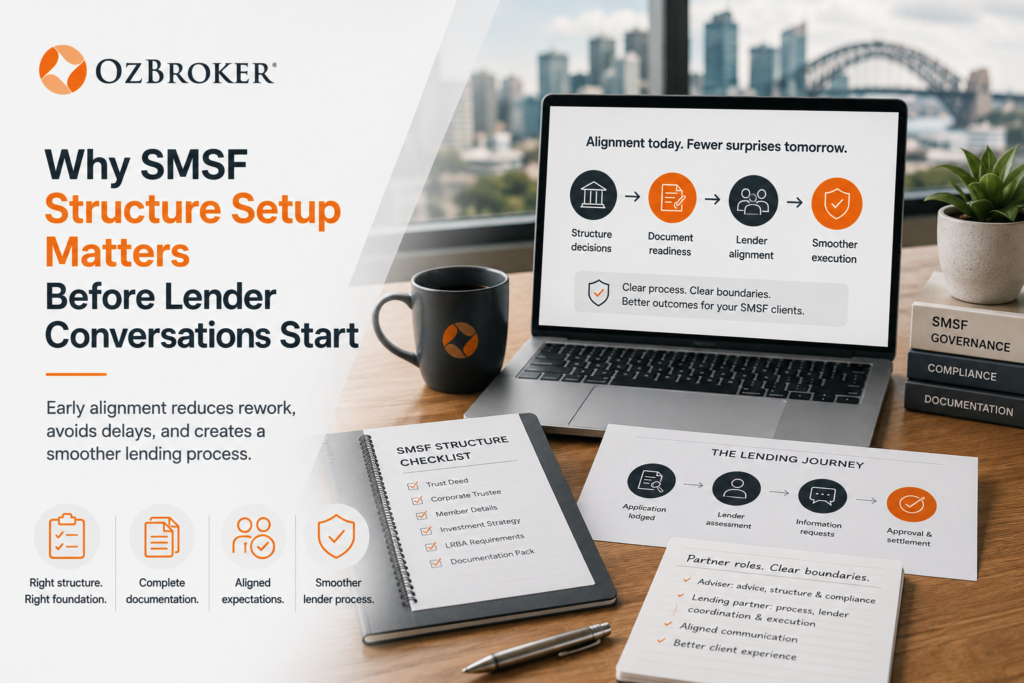
It means checking, at a practical level, whether the intended SMSF structure, documentation approach and transaction pathway are likely to work within common lender process requirements.
A practical, adviser-friendly approach may include the following.
Early feasibility-style input
Before the matter becomes time-critical, a lending specialist can provide high-level input on likely friction points.
This allows the accountant, tax adviser or SMSF specialist to remain in control of the strategy and advice discussion, while also understanding whether the borrowing pathway may raise process issues later.
Checklist-based document readiness
SMSF borrowing matters usually benefit from clear document expectations early.
A checklist-based approach can help identify what may be needed, what is already available, and what could create delays if left until loan assessment begins.
This can reduce last-minute document chasing and avoid unnecessary back-and-forth between parties.
Structure-to-lender expectation alignment
Some lender questions arise because the structure is not presented in a way that is easy to assess.
Early alignment can help sanity-check how the setup may be viewed in a lender workflow, so the eventual handoff is cleaner and more predictable.
Coordinated handoffs and clear boundaries
Clear role boundaries matter.
The accountant, adviser or SMSF specialist should remain responsible for advice, tax, compliance and governance matters within their scope.
The lending specialist should focus on borrowing feasibility, lender coordination, document flow, compliance process checks and settlement coordination.
When each party understands their role early, the client experience is usually smoother.
How SMSF partner support can help accountants and advisers
This is where SMSF partner support can add value for accountants, tax advisers and SMSF specialists.
OzBroker supports referral partners by helping identify lender process expectations early, improving document readiness and coordinating the lender-facing steps of the transaction.
The aim is not to take over the client relationship.
The aim is to support the execution layer while the adviser maintains control of the advice process and client relationship.
In practical terms, OzBroker can assist with:
- early SMSF lending feasibility discussions
- lender policy and process coordination
- document readiness checks
- lender-facing communication
- compliance process support
- settlement coordination
- clear handoffs between adviser, client and lender
OzBroker does not provide legal drafting or legal advice. Any SMSF structure, tax, legal or compliance advice should remain with the appropriate qualified professionals.
Early lender alignment should also be understood as a way to reduce avoidable friction, not as a guarantee of loan approval or transaction outcome.
The takeaway
SMSF structure setup matters before lender conversations start because the lending process is often affected by decisions made much earlier.
When the structure, documentation and lender workflow are considered early, advisers can reduce avoidable delays, improve client communication and create a cleaner path from strategy to execution.
If you have a client scenario where SMSF structure setup is underway and borrowing may form part of the plan, a brief alignment conversation can help clarify likely lender process expectations before the matter becomes time-critical.
OzBroker can work with you to review borrowing feasibility, document readiness and handoff steps — so you maintain control of the advice and client relationship while reducing downstream lending delays.