
Recent reporting has made one thing harder to ignore.
The policy environment is shifting in a way that may bring more accountants back into SMSF-related structure discussions.
Broader tax reform pressure is moving the property structure conversation.
Industry reporting also suggests that the LRBA path for SMSFs may be closed off in relation to residential property as part of the same political deal.
That will naturally create more review activity.
But more relevance does not automatically create more readiness.
And that is where many discussions become weaker than they first appear.
Why SMSF May Return to the Table
It is easy to see why SMSF may now return to the table for some clients.
If traditional property-holding assumptions are under more pressure, then SMSF will become harder to ignore as part of the review.
That much is straightforward.
What is less straightforward is whether the path is still workable once the lending side is properly tested.
That is where the distinction becomes important.
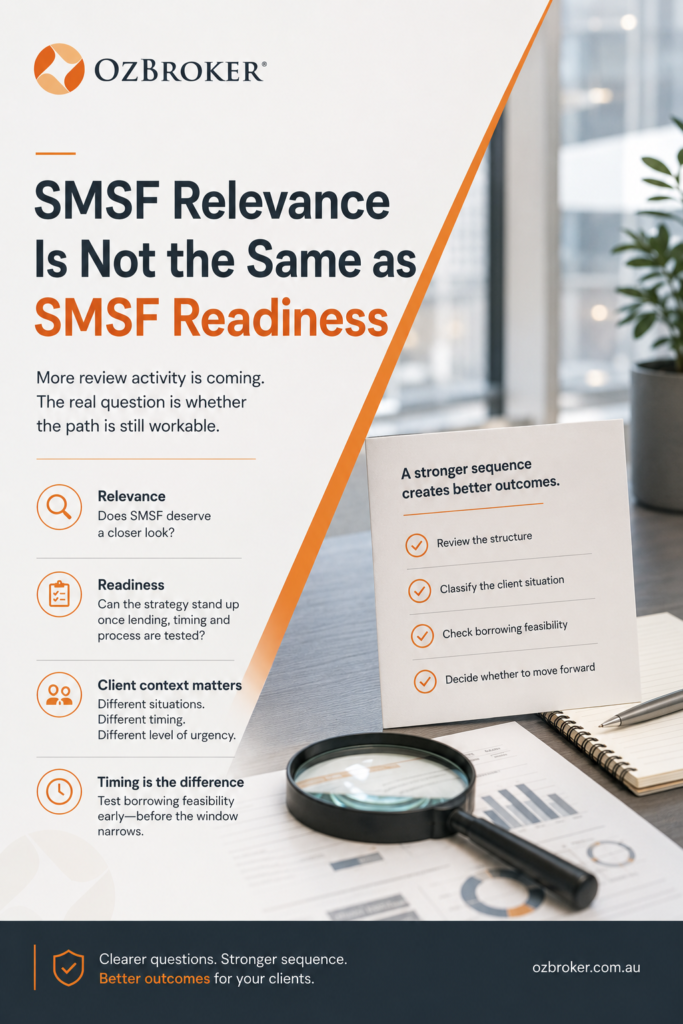
SMSF relevance is one question.
SMSF readiness is another.
Relevance Asks One Question. Readiness Asks Another.
Relevance asks whether the structure deserves a closer look.
Readiness asks whether the strategy still stands up once borrowing feasibility, lender requirements, timing, and process reality are considered.
Those are not the same level of judgment.
And under the current policy turn, the gap between them matters more.
A client can have a strong rationale for reviewing SMSF and still have a weak path forward.
That is not because the idea was irrational.
It is because the discussion moved too far on rationale before the execution side had been pressure-tested.
Not Every SMSF Client Is in the Same Position
This is where client classification becomes important.
Not every SMSF-related client is in the same position.
An existing residential SMSF property investor is different from a client who has started the SMSF process but has not purchased yet.
A client with an existing residential property LRBA is different from a client still trying to enter a new residential SMSF borrowing arrangement.
A commercial SMSF lending conversation is different again.
And a client who has already exchanged contracts is not in the same position as someone still working through feasibility.
Those distinctions matter because the wrong frame can create the wrong response.
If every client is treated as urgent, the conversation becomes panic-led.
If every client is treated as unaffected, the conversation becomes complacent.
Neither is useful.
The Better Frame: Separate Relevance from Readiness
The better approach is to separate relevance from readiness.
For some clients, the practical question may be:
“Does SMSF still deserve to be reviewed?”
For others, it may be:
“Has the client already moved far enough that contract timing now matters?”
For another group, the question may be:
“Is this residential borrowing or commercial lending?”
And for clients who have started the SMSF process but have not purchased yet, the sharper question may be:
“Is the lending path still workable before timing narrows further?”
That is a very different level of conversation.
Where Accountants Can Get Caught in the Middle
This is also where accountants can get caught in an awkward middle.
They do not want to overstep into lending.
They do not want to lose control of the advisory relationship.
They do not want to present SMSF as the answer before the full picture is clear.
All of that is fair.
But the alternative cannot be to leave the lending side until the very end, especially if the current window is becoming less open-ended.
That is the point where a structure discussion can quietly drift from professional review into assumption-led momentum.
The structure starts to make sense.
The client becomes interested.
The timing starts to feel urgent.
Then borrowing gets tested after the emotional and practical commitment has already built.
That is where late friction becomes more expensive.
Not because SMSF was necessarily wrong.
But because the readiness test arrived too late.
A More Disciplined Professional Position
The stronger professional position is more disciplined.
Not:
“SMSF is now the solution.”
But:
“For suitable clients, SMSF may still be worth reviewing. The question is whether the borrowing side should now be tested earlier and faster than before.”
That is a safer and more useful frame.
It keeps the accountant in the advisory lead.
It avoids overclaiming.
And it recognises that, in this environment, readiness matters just as much as relevance.
A structure that looks compelling in theory is not yet a strategy.
It only starts to become one once it can survive both the strategic discussion and the lending reality check.
The Practical Takeaway
The practical takeaway is simple.
Recent policy reporting may increase the number of clients asking whether SMSF deserves a closer look.
That does not mean the conversation should move faster than its execution reality.
It means the opposite.
The faster the conversation moves, the more important the sequence becomes.
If the client is actively reviewing structure, and borrowing may affect whether the path remains viable, then readiness should be tested before the structure discussion hardens.
Especially where the client has already started the SMSF process but has not purchased yet.
That is where contract timing, lender appetite, and execution timing can quickly become part of the real decision.
Relevance opens the door.
Readiness determines whether the conversation should keep moving.