For accounting partners, one of the main challenges surrounding the 10 August deadline is not simply the increase in client enquiries.
It is that many of those enquiries arrive incomplete.
A client may understand that the date is important but may not know how it applies to their own circumstances. They may ask whether they can still proceed without clearly distinguishing between:
- the status of the property purchase
- the SMSF and LRBA structure
- document readiness
- the lending pathway
- tax, legal and investment considerations
This creates a practical challenge for the accounting partner.
Before determining whether an enquiry should move into lending review, the matter first needs to be classified correctly.
A clear classification process can reduce confusion, manage client expectations and help each professional remain within the appropriate scope of advice.
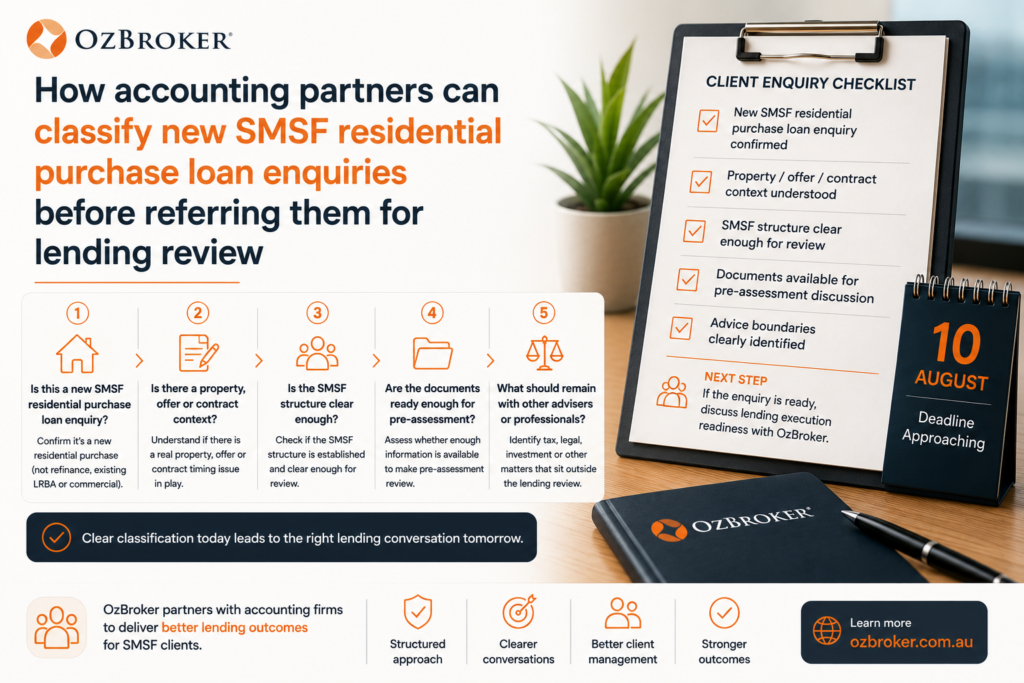
1. Confirm Whether It Is a New SMSF Residential Purchase Loan Enquiry
The first question is also the most important:
Is the client actually seeking finance for a new residential property purchase through an SMSF?
This may sound straightforward, but different SMSF lending matters can easily become grouped together when a deadline becomes the focus of the conversation.
For example, the following matters should not automatically be treated as part of the same lending pathway:
- an SMSF refinance
- an issue involving an existing limited recourse borrowing arrangement
- a commercial property or business real property transaction
- a broader SMSF strategy or structuring enquiry
- a general question about borrowing capacity or future investment options
A refinance is not the same as a new purchase. An existing LRBA issue is not the same as a new residential acquisition. A commercial property scenario may also involve a different lending and advice pathway.
Before discussing urgency, the accounting partner should first establish the nature of the enquiry.
Without this initial classification, incorrect assumptions can arise at the very beginning of the process.
2. Establish Whether There Is a Genuine Property or Contract Context
Once the matter has been identified as a potential new SMSF residential purchase enquiry, the next step is to understand whether there is an active transaction.
Relevant questions may include:
- Has the client identified a specific property?
- Has an offer already been made?
- Has a contract been signed?
- Are there finance, settlement or other contractual timeframes?
- Is the enquiry still hypothetical or exploratory?
A client who is considering a future purchase is in a different position from a client who has already entered negotiations or signed a contract.
Those situations should not be treated in the same way.
The accounting partner does not need to interpret contractual obligations or provide legal advice. However, the transaction context should be clear enough for the lending enquiry to be framed appropriately.
Where contractual consequences or deadlines need to be interpreted, those questions should remain with the client’s solicitor or conveyancer.
3. Determine Whether the SMSF Structure Is Sufficiently Clear
A time-sensitive lending review becomes more difficult when the underlying SMSF or LRBA structure is still uncertain.
Before a meaningful lending pre-assessment can take place, it is helpful to understand whether:
- the SMSF has already been established
- the trustee structure is known
- the proposed borrowing structure has been considered
- the bare trust or holding trust requirements have been addressed
- the relevant parties and entities have been identified
- any outstanding structural issues need to remain with the accountant, adviser or solicitor
This does not mean the accounting partner is responsible for making lending decisions or resolving every structural issue before referral.
The purpose is to determine whether the matter is sufficiently developed for a useful lending conversation to begin.
Where the structure remains uncertain, it may be more appropriate to resolve those issues with the relevant professional before progressing into lending execution.
4. Assess Whether the Enquiry Is Ready for Pre-Assessment
One of the most common misunderstandings in deadline-driven situations is the assumption that urgency and readiness are the same thing.
They are not.
A client may feel that their matter is urgent while still having:
- incomplete financial information
- unclear borrower or trustee details
- missing SMSF documents
- unresolved contribution or liquidity questions
- insufficient information about the proposed property
- incomplete income, asset or liability details
- uncertainty about the required loan amount
In these circumstances, speed alone does not solve the problem.
It can instead create repeated follow-up requests, duplicated work and unrealistic expectations.
That is why document and information readiness should be considered during the initial triage process.
The question is not whether every document is complete or perfect.
The question is whether enough information is available to make a pre-assessment discussion meaningful rather than premature.
5. Identify Which Questions Belong Outside the Lending Review
Classification is important because not every client question belongs within the lending process.
Some matters may remain primarily with the accountant, including questions relating to:
- SMSF compliance
- contributions
- cash flow within the fund
- tax treatment
- financial statements
- trustee or fund administration matters
Other questions may require input from a solicitor or conveyancer, particularly where they relate to:
- contracts
- ownership structure
- bare trust documentation
- settlement obligations
- legal rights and responsibilities
Questions involving investment suitability, strategy or personal financial advice should remain with the appropriately licensed adviser.
For accounting partners, the objective is not to resolve every issue before making a referral.
It is to ensure the roles are clear enough for the lending review to remain within the correct professional boundaries.
This becomes particularly important during a deadline period, when clients may combine tax, legal, lending and investment questions into a single request and expect one definitive answer.
6. Decide When the Matter Is Ready for Lending Execution Review
A lending execution readiness conversation may be appropriate once:
- the matter has been confirmed as a new SMSF residential property purchase enquiry
- the property or contract context is reasonably clear
- the SMSF and borrowing structure is sufficiently developed
- enough financial and supporting information is available for pre-assessment
- any significant tax, legal or investment questions have been directed to the relevant professional
At this stage, OzBroker can assist with the lending component of the process.
Our role may include:
- clarifying the likely lending pathway
- identifying the information required for pre-assessment
- reviewing whether the enquiry is sufficiently ready to proceed
- identifying potential lending or execution issues
- supporting the client and their professional advisers through the finance process
Our role is not to replace the accountant, financial adviser, solicitor or conveyancer.
We do not provide tax, legal or investment advice.
Maintaining that distinction is not only important from a compliance perspective. It also supports a clearer and more coordinated experience for the client.
A More Structured Referral Pathway
As a deadline approaches, it becomes easier for client enquiries to feel rushed, fragmented and difficult to manage.
A stronger approach is to slow down the first step just enough to classify the matter properly.
Before referring a client for lending review, consider the following questions:
- Is this a new SMSF residential property purchase loan enquiry?
- Is there a genuine property, offer or contract context?
- Is the SMSF and LRBA structure sufficiently clear?
- Is enough information available for a meaningful pre-assessment?
- Which questions should remain with the accountant, adviser, solicitor or conveyancer?
- Is the matter ready to move into lending execution review?
This classification process does not create unnecessary delay.
It helps make the next step more focused, efficient and useful.
For accounting firms managing deadline-sensitive SMSF client enquiries, that can be the difference between simply reacting to urgency and managing it professionally.
Speak With OzBroker About Lending Readiness
If you are assisting a client with a new SMSF residential property purchase and would like to determine whether the matter is ready for lending review, OzBroker can help assess the lending execution pathway.
Our focus is on helping accounting partners and their clients understand what is required for a meaningful pre-assessment and what the next lending steps may involve.
All tax, legal and investment matters should continue to be addressed by the appropriately qualified professionals.