
The SMSF Conversation Has Changed
Two recent developments have changed the shape of the SMSF conversation in Australia.
First, recent reporting has pointed to broader tax reform pressure moving further into the property structure conversation. Second, industry reporting indicates that the proposed changes may close off the LRBA path for SMSFs in relation to residential property.
A lot of commentary will naturally focus on the tax angle. That is understandable. But for accountants, the more important shift may not be the headline itself. It may be the change in timing.
Because this moment does not simply make SMSF more relevant for some clients. It also makes it harder to treat the lending side as something that can be checked later.
And more importantly, the timing question is no longer only about when the law formally changes. It is also about contract timing, lender appetite, and whether the client is still inside a workable transaction window.
This Is Not Just a Tax Story
It is tempting to read the latest policy signal as a tax-only development. But that is too narrow.
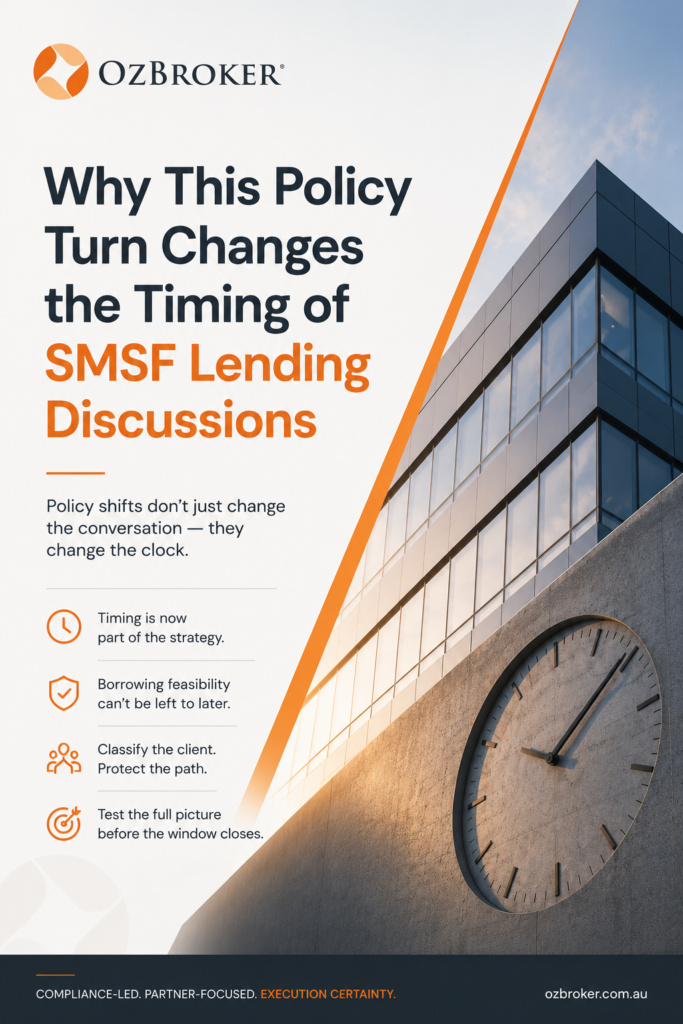
What has changed is not only the structure conversation. It is also the clock around that conversation.
For a long time, many SMSF discussions have followed the same sequence. A tax or structure trigger starts the review. The client becomes interested in the option. The structure logic starts to take shape. Then borrowing feasibility enters later, once momentum is already there.
That sequence was already weaker than many firms assumed. Under the latest policy signal, it may also become slower than the window allows.
The Timing Window Now Matters
That is especially true for clients who have started the SMSF process but have not purchased yet.
For those clients, the issue is not only whether SMSF remains worth reviewing. The issue is whether the client can still move through the practical steps in time.
Has the client exchanged contracts? Is the asset residential or commercial? Is borrowing required? Is lender appetite still available? Could lenders adjust their settings before the formal rule change date?
Those questions are not secondary anymore. They may determine whether the path is still live.
That is why this should not be treated as a policy-summary moment. It is better understood as a sequencing moment.
SMSF Is Not Suddenly the Answer
The proposed changes do not mean every client should now rush into SMSF.
They do not mean SMSF is suddenly the answer.
And they certainly do not mean tax change should be treated as a conclusion rather than a trigger.
But they do mean this question matters more now:
If SMSF is worth reviewing for this client, can the lending side still afford to come in late?
That is a better question than simply asking whether the structure is attractive.
Borrowing Feasibility Belongs Earlier
Because a good SMSF discussion is not just a tax discussion. It is also a borrowing discussion, a timing discussion, a compliance discussion, and an execution discussion.
If one of those only enters after the structure story already feels settled, the team may not be testing the real path. They may only be testing what is left after assumptions and timing have already narrowed the options.
The practical takeaway is narrow but important.
Tax pressure may trigger the review. Policy change may bring SMSF back into more conversations. But neither of those should be allowed to carry the strategy on their own.
If borrowing feasibility may affect whether the structure works, then the lending side belongs earlier in the discussion than many firms are still used to.
Accountants Do Not Need to Own Lending
That does not mean accountants need to own lending.
It means they may need to recognise earlier when the lending side could change whether the structure discussion should keep moving at all.
It also means client situations need to be separated properly.
Existing residential SMSF property investors are not in the same position as clients who have started the process but have not purchased yet. Commercial SMSF lending is not the same conversation as residential SMSF borrowing. A client who has already exchanged contracts is not in the same timing position as one who is still pre-purchase.
Those distinctions matter.
Without them, the market can easily move from awareness into panic. That is not helpful.
A Clearer Sequence Is Needed
What is helpful is a clearer sequence.
Review the structure. Classify the client situation. Check whether borrowing is relevant. Pressure-test lender appetite and timing before the structure hardens. Then decide whether the strategy should keep moving.
The more useful question right now is not:
“Is SMSF now the answer?”
It is:
“If SMSF is worth reviewing for this client, should the borrowing path be pressure-tested before the structure hardens?”
That is a more disciplined way to respond to this moment.
It keeps the accountant in the advisory lead. It avoids overclaiming. And it gives the client a stronger decision before timing and assumptions narrow the path.